Carbohydrate structures
Stereoisomerism at sp3 carbon
Examples of Aldohexoses
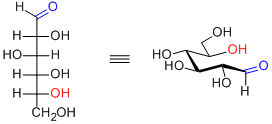
The aldohexoses are a family of reducing monosaccharides that each contains a 6-carbon chain and an aldehyde at C-1. They may exist in a variety of forms in solution, most often as the cyclic hemiacetal pyranose and furanose forms as well as the familar acyclic form in which the aldehyde functional group is revealed. The Fischer depictions and rotatable structures below show the stereochemical relationships between the diastereomeric beta anomers of D-Glucose, D-Mannose, and D-Galactose in both their pyranose and furanose forms. Manipulate the models so that you are able to answer these questions:
- How do the 3 sugars differ in terms of their stereochemical properties? Are they related as enantiomers, diastereomers, epimers, etc.?
- Identify C-1 in each of the molecules; this will be the hemiacetal carbon which differs from the others since it has two O atoms attached.
- Using Newman depiction terminology, what is the approximate relationship between the hydroxyl groups at C-2 and C-3 of each sugar?
- Using the same type of terminology, what is the approximate relationship between the hydroxyl groups at C-3 and C-4 of each sugar?
- Work out the configuration (using R or S) for C-2 and C-4 in each of the three molecules and see how they differ for the three isomers.
Acyclic D-Glucose; OH-5
Acyclic D-Mannose; OH-5

Acyclic D-Galactose; OH-5

D-Glucose in pyranose form
D-Mannose in pyranose form
D-Galactose in pyranose form
In order to produce the pyranose form (6-membered ring, OH-5 in each case must attack the C-1 aldehyde to form the hemiacetal (shown above). It is also possible for OH-4 to attack C-1 and generate the furanose forms (5-membered ring). The models below show the consequences of this for D-Glucose, D-Mannose, and D-Galactose.
Acyclic D-Glucose; OH-4

Acyclic D-Mannose; OH-4

Acyclic D-Galactose; OH-4
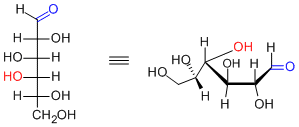
D-Glucose in furanose form
D-Mannose in furanose form
D-Galactose in furanose form
The pyranose forms for all three sugars are fairly obvious; the OH-5 group attacks the C-1 aldehyde and similar 6-membered rings are formed in each case. The differences in these structures are seen in the stereochemistry at C-2 or C-4 while the stereochemistry at C-5 is the same in each sugar. In the furanose form there is a change seen in the galactose case. Since the stereochemistry at C-4 is the opposite to that observed in glucose and mannose, the group at C-4 of the furanose ring will be inverted in relation to the other two structures.